Showing posts with label Circular Economy. Show all posts

Thursday, 27 November 2014

Circular Economy

Circular economy
·        Increase recycling/re-use of municipal waste to 70% in 2030;
·        Increase packaging waste recycling/re-use to 80% in 2030 with material-specific targets set to gradually increase between 2020 and 2030 (to reach 90 % for paper by 2025 and 60% for plastics, 80% for wood, 90% of ferrous metal, aluminium and glass by the end of 2030);
·        Phase out landfilling by 2025 for recyclable (including plastics, paper, metals, glass and bio-waste) waste in non-hazardous waste landfills – corresponding to a maximum landfilling rate of 25%;
·        Reduce food waste generation by 30% by 2025;
·        Introduce an early warning system to anticipate and avoid possible compliance difficulties;
·        Ensure full traceability of hazardous waste;
·        Increase the cost-effectiveness of Extended Producer Responsibility schemes by defining minimum conditions;
·        Simplify the reporting obligations and lighten obligations affecting SMEs;
·        Harmonise and streamline the calculation of the targets and improve the reliability of key statistics;
·        Improve the overall coherence by aligning definitions and removing obsolete legal requirements


Javier tabernilla


Tuesday, 25 November 2014

Researching Circular Economy!


Aleksi, Edward & Elina
Circular Economy
This is a clear overview of circular economy and I thought of sharing with those who have no idea about what it is... Enjoy.....

What is a circular economy?

Since the industrial revolution, waste has constantly grown. This is because our economies have used a “take-make-consume and dispose” pattern of growth – a linear model which assumes that resources are abundant, available and cheap to dispose of.

What we need is a more circular economy.  This means re-using, repairing, refurbishing and recycling existing materials and products. What used to be regarded as ‘waste’ can be turned into a resource. All resources need to be managed more efficiently throughout their life cycle.
Using resources more efficiently will also bring new growth and job opportunities. Better eco-design, waste prevention and reuse can bring net savings for EU businesses of up to EUR 600 billion, while also reducing total annual greenhouse gas emissions. Additional measures to increase resource productivity by 30% by 2030 could boost GDP by nearly 1%, while creating 2 million additional jobs.

Moving towards a circular economy is at the heart of the resource efficiency agenda established under the Europe 2020 Strategy for smart, sustainable and inclusive growth. The main ideas on how to do more with less are being taken further in the EU's Environment Action Programme to 2020.
The European Commission's 'Generation Awake' campaign on resource-efficiency  focuses on what each one of us can do in our daily life to save water, energy and other natural resources, and turn waste into a resource.

Circular economy, saving resources and creating jobs are the main themes of Green Week 2014, the biggest annual conference on European environment policy.

Reference: http://ec.europa.eu/environment/circular-economy/

Edward

Sunday, 23 November 2014

Monday, 10 November 2014

Field task in Turku

Touring around the nice city of Turku we found some examples of circular economy!


Aleksi, Edward & Elina

Thursday, 30 October 2014

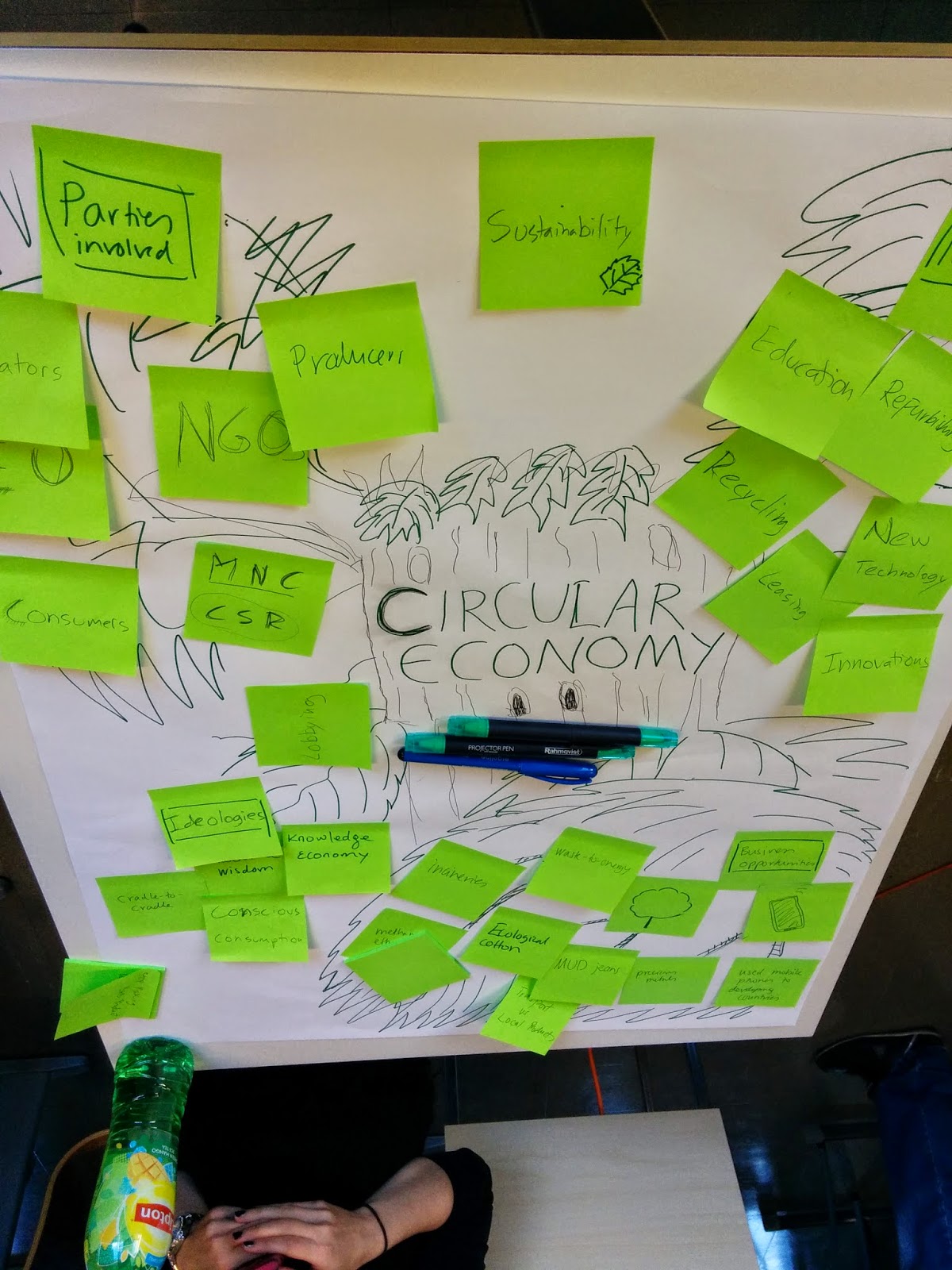
Circular Economy: Definitions and Stakeholders


CIRCULAR ECONOMY DEFINED 


"The circular economy refers to an industrial economy that is restorative by intention; aims to rely on renewable energy; minimise, tracks and eliminates the use of toxic chemicals; and eradicates waste through careful design." 
(Ellen MacArthur Foundation)

The definition by Ellen MacArthur Foundation concentrates on designing industrial production so that environmental benefits can be gained.

"Circular economy means re-using, repairing, refurbishing and recycling existing materials and products. What used to be regarded as ‘waste’ can be turned into a resource. All resources need to be managed more efficiently throughout their life cycle." 
(European Commission)

This definition of circular economy by the European Commission emphasizes the importance of efficient resource management from the point of view of environment as well as financial benefits. Consequently, besides reducing environmental impact, the goals of the EC's Circular Economy package that includes the communication "Towards a circular economy: A zero waste programme for Europe" (2014) are related to creating jobs and boosting the economy.

Here are some examples on European companies that have found new business opportunities in circular economy:

MUD jeans (the Netherlands)
Business model of leasing jeans and recycling of old jeans to make new cotton thread. Using only organic and recycled cotton.

Fonebank (the UK)
Old phones are repaired and sold again to developing countries and also to Europe.

Umicore (Belgium)
Old phones and other high-tech products dismantled and precious metals are collected.
Win-win-win for environement and businesses. Creating new jobs and serving as a response the shortage of raw materials in Europe.

The following video explains how these companies do their business:


I found this video very inspiring and liked especially the idea of leasing clothes. Actually, I liked the idea so much that I started looking for a birhtday present for my boyfriend on MUD Jeans' web site :).

More examples on companies can be found on this web site as well:

http://www.ellenmacarthurfoundation.org/case_studies

Elina